AI in Hiring Systems
[Internal study at Peepal Design]
A qualitative study on how candidates experience, adapt to, and make sense of AI at every stage of the hiring process.
Role
UX Researcher
Timeline
6 weeks

Context
Hiring in India has changed significantly over the last few years. Most companies now use some form of automated resume screening. AI-powered match scores surface on job platforms. First round interviews are increasingly conducted without a human present. For candidates, this isn't a distant technological shift, it's the actual texture of their job search.
What's less understood is what this experience does to people. Not whether AI hiring works, but what it asks of candidates: the adaptations it demands, the uncertainty it produces, and what gets lost for those who can't navigate it on its own terms.
This study started from that question.
The research question
We weren't evaluating AI hiring tools. We were trying to understand the candidate's side of a process that had been largely designed without them in mind.
The central question: how does the presence of AI shape the way candidates experience, adapt to, and make sense of the hiring process, and whose experience does it disadvantage most?
Research design
We chose in-depth interviews over surveys because the phenomena we were studying, including belief formation, emotional response, and adaptive behaviour, don't surface in closed questions. We needed to understand why candidates did what they did, not just what they did.
PARTICIPANTS
11 participants across India, recruited to represent variation in experience level, industry background, job search intensity, and familiarity with AI tools. The sample spanned freshers, mid-level professionals, and senior candidates from IT, finance, media, consulting, and social sector roles. Active and passive job seekers were both included. This was a deliberate choice, since passive candidates often have a different relationship to automated screening than those actively applying.
STRUCTURE
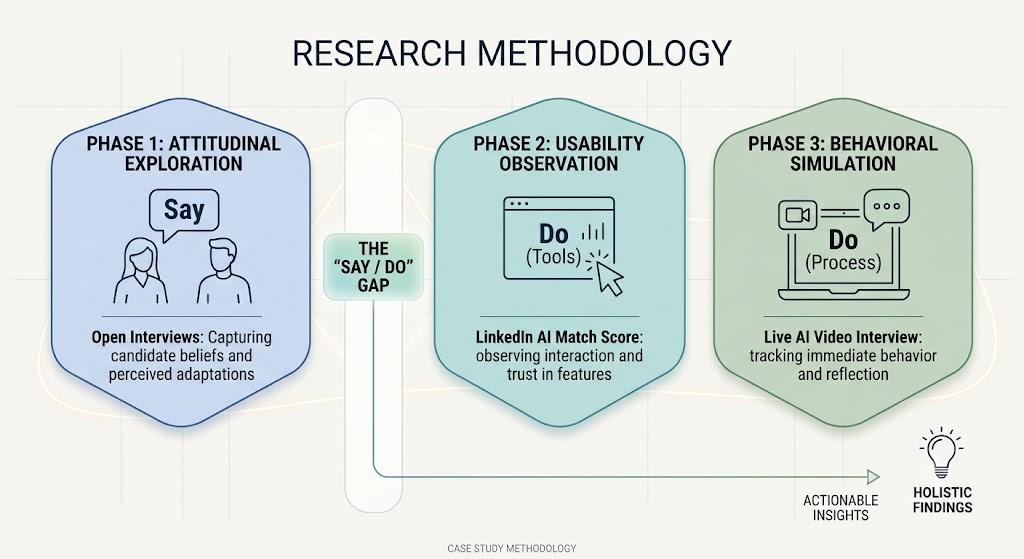
Each session ran 60 to 90 minutes across three phases.
Phase 1 was an open-ended exploration of how participants currently search, apply, and manage the hiring process. We focused on emotional experience, platform choices, and what they understood about how screening worked.
Phase 2 was a live usability walkthrough of LinkedIn's AI Match Score. We observed how participants navigated to the feature, their immediate reaction, and how they talked about trust and usefulness.
Phase 3 involved participants completing a live AI video interview. We observed navigation, response mechanics, and emotional state, then asked them to reflect immediately after.
Combining interview and usability observation in a single session was a deliberate methodological choice. It let us compare what participants said they did with what they actually did in practice. In several cases, the gap between the two was itself a finding.
MY ROLE
I developed the discussion guide, conducted fieldwork, and co-led synthesis and report writing end to end.
Analysis
APPROACH
We used thematic analysis, moving from session-level debriefs to cross-participant pattern identification. Each session was debriefed immediately after, while observations were fresh. We built the synthesis layer by layer: first cataloguing individual observations, then clustering into themes, then pressure-testing those themes against the full dataset before writing them up.
PARTICIPANT SEGMENTATION
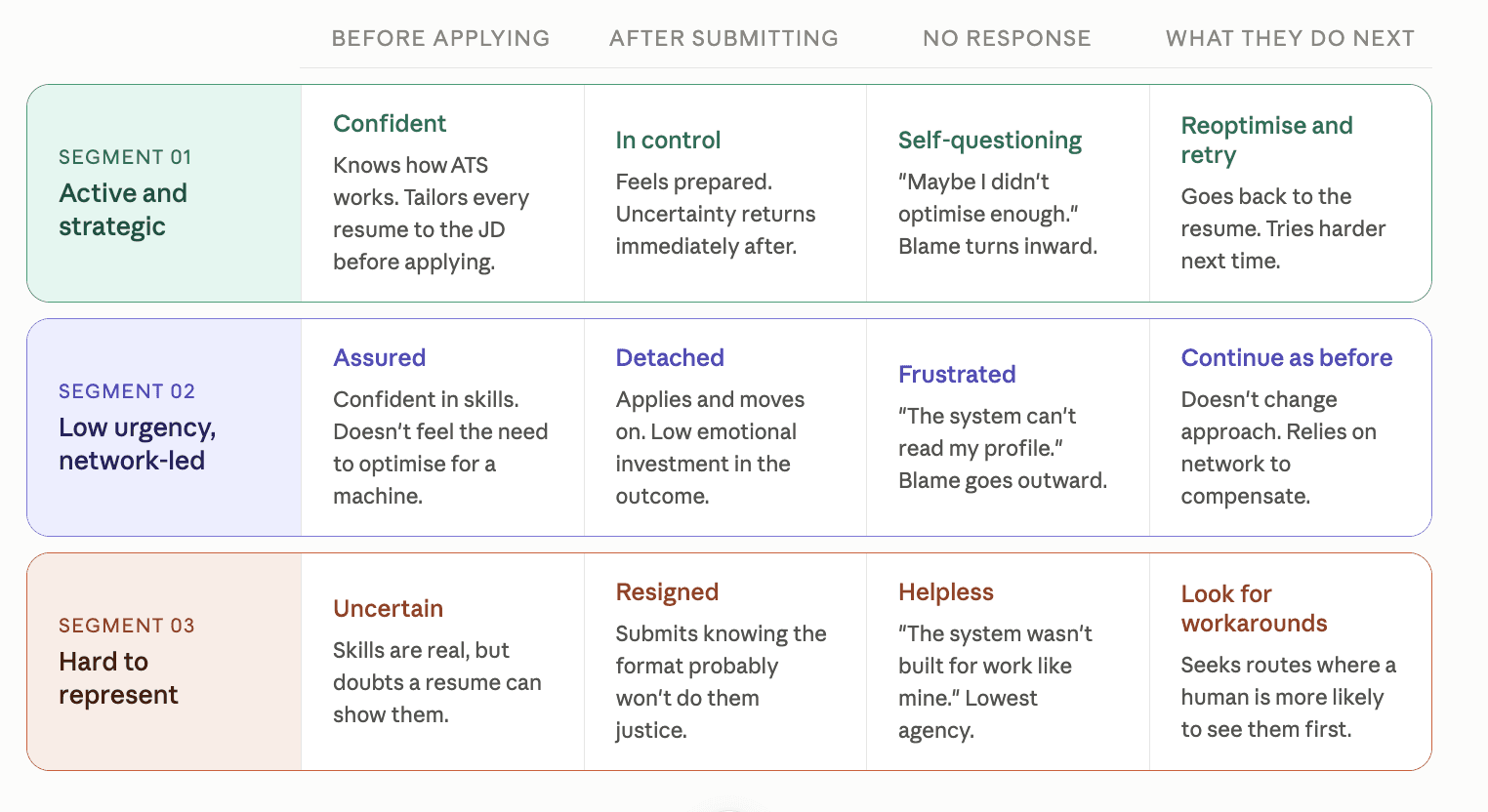
Early in analysis, we attempted to group participants by observable traits such as job search intensity, platform use, and ATS awareness. The segments didn't hold. What actually differentiated participants wasn't behaviour in isolation, but the combination of their sense of agency over the system, how they understood ATS, and where they directed attribution when things didn't work.
The three segments that emerged came from sitting with that combination until the groupings became stable and non-arbitrary. A segment was only accepted when it could be traced back to a distinct set of goals, motivations, and pain points, not just a surface pattern.
Findings
After submitting, the process went dark.
Candidates had no visibility into what happened to their application. They didn't know if it was seen, filtered, or whether the role had already been filled. Most adapted by emotionally detaching, not from resignation, but because staying invested produced no information. To feel productive, they applied to more roles. More volume meant more automation. More automation meant more silence. The loop fed itself.
Candidates had built a theory of ATS without being taught one.
All 11 participants were aware that automated screening existed. None learned this from a company. They pieced it together from peers, rejection timing, and platform signals: auto-filled forms, generic emails that arrived too fast to be human, resumes parsed with the wrong details. Their understanding was partial and unverifiable, but it was enough to change how they wrote resumes.
Three candidate segments emerged from how they related to this system.
LinkedIn's AI Match Score was used less than expected, trusted less than hoped.
Nine of eleven participants didn't open the feature without prompting. Once they engaged, accuracy was the core problem. The feature flagged skills as missing that candidates clearly had. It matched on years of experience without accounting for domain. It confirmed things candidates already knew, like having an MBA or listing communication skills, without adding anything that would help them decide whether to apply.
What participants wanted was a feature that functioned like a thoughtful recruiter, one that could infer related skills, read domain context, and identify what actually mattered for the role. What they got was keyword matching with a confidence score. Trust dropped sharply the moment the feature surfaced something that didn't hold up, and it didn't recover.
The AI interview made it harder to perform.
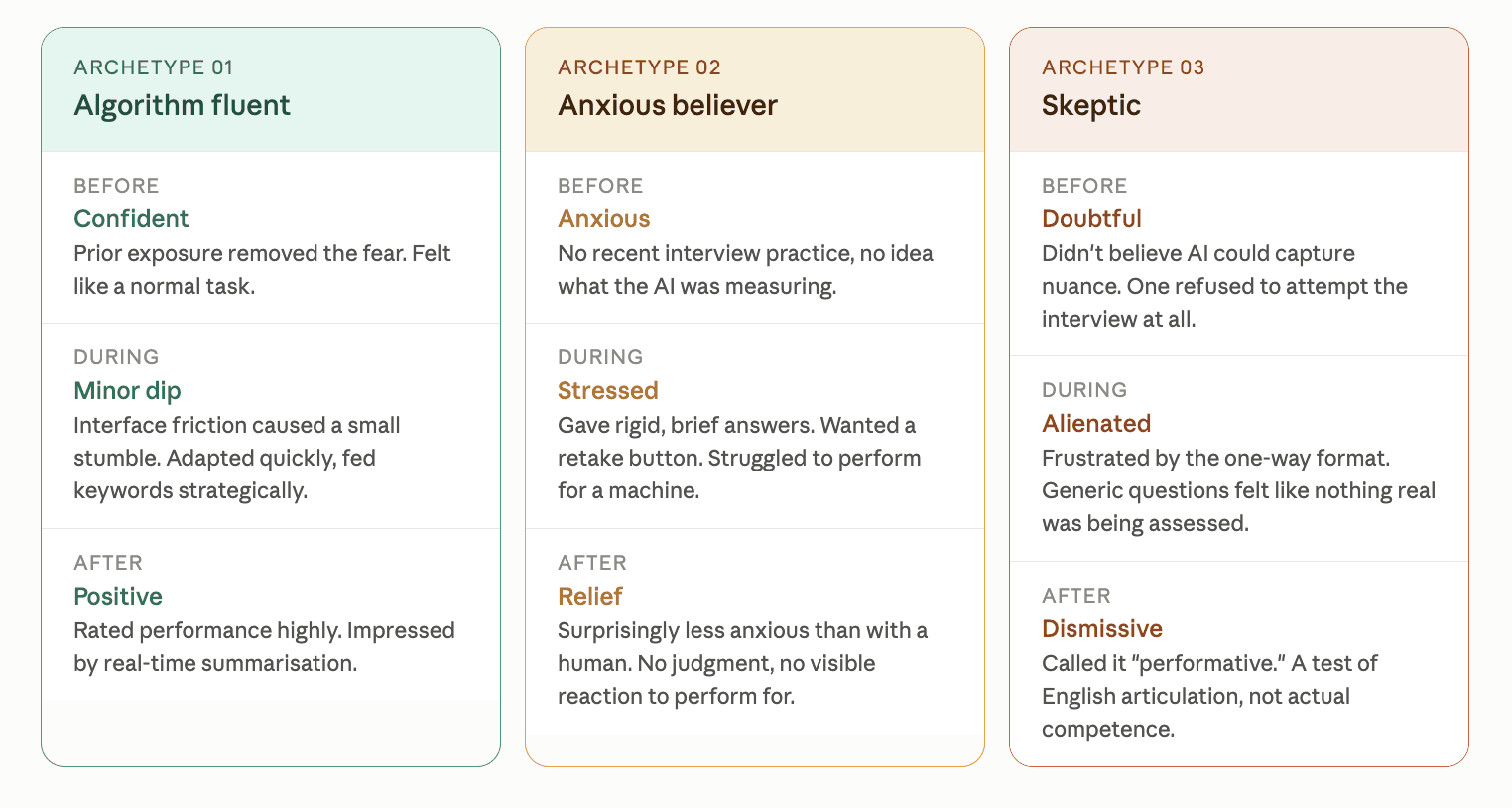
Without any signal from the other side of the conversation, candidates couldn't calibrate. Several gave shorter, more guarded answers than they would have in a human interview, not because they had less to say, but because nothing invited more. The AI's consistent positive feedback made evaluation feel meaningless. If everything is affirmed, the feedback stops serving any purpose.
Usability friction compounded this. The submit mechanic wasn't intuitive. Several participants waited in silence, expecting automatic detection. No progress indicator meant candidates couldn't pace themselves. Many wanted to redo an answer and couldn't find the option.
Three archetypes emerged in how participants experienced the interview.
Fairness wasn't about bias. It was about what the format structurally rewarded.
Candidates who had been through AI interviews before, who were fluent and confident on camera, and who could optimise resumes for keyword filters had a structural advantage. This had little to do with actual fit for the role. A deeply capable candidate who communicated with depth rather than density, or who hadn't encountered the format before, was navigating a system that wasn't designed around them.
On where AI should have authority: the consensus held across almost every participant. Acceptable for high-volume initial screening. Not acceptable for interviews or final decisions. Even participants who trusted AI's objectivity drew a firm line at the point where judgment about a whole person was required.
Reflections
The story wasn't about trust in AI. It was about legibility, who the system was built to read, and who it wasn't. Candidates weren't refusing to engage. They were building informal workarounds to cope with a process that offered no feedback and no recourse: keyword strategies passed between peers, dual resume systems for different application tiers, direct outreach to reach a human before screening could filter them out.
AI in hiring has reduced operational burden for companies and increased navigational burden for candidates. That tension doesn't have to be permanent. But resolving it starts with a question most platform design hasn't seriously asked: what does the system owe the person it rejects?